
Picture the confrontation scene at the end of Return of the Jedi. Luke Skywalker is on the floor, being electrocuted by the Emperor's lightning. He is screaming. Standing beside the Emperor is Darth Vader, watching his own son die.
Think about who Vader is at this moment. He has choked people with his mind at will. He stood on the bridge of the Death Star while it murdered an entire planet. This is a genuinely bad guy, three films deep into being a bad guy. But in this scene, his head turns. He looks at the Emperor. He looks at his son. He looks at the Emperor again.
Then he picks the Emperor up and throws him down the reactor shaft, sacrificing his own life to save Luke. In one decision, a villain becomes a hero.
That scene explains everything I want to tell you today.
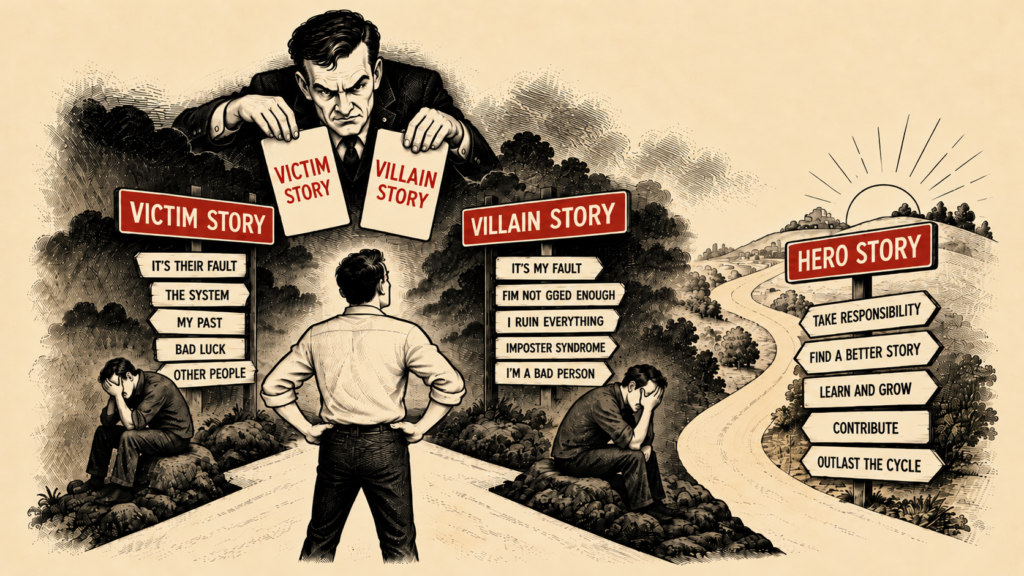
Over thirty years as a therapist and executive coach, working with thousands of people across thirty-three countries, from senior executives wrestling with business problems to students fighting for their mental health, I noticed that almost everyone explains their problems using one of two stories. There's the victim story, where everything wrong in my life is caused by what's outside me. And there's the villain story, where everything wrong in my life is caused by me.
Which story you're selling yourself determines how stuck you are, and there's a third story available that changes everything. Today, I'll walk you through all three, and the five steps that get you from the first two to the last one.
A quick thanks to everyone for the reviews and feedback on my new book, Inner Propaganda: Leading Hearts and Minds Through Turbulent Times; you can find it here.
The victim story
The victim story says my problems happen to me. The blame lives elsewhere. My parents, my partner, my kids, my teachers, the government, the economy, the system. Listen to how someone describes what's going wrong in their life, and you'll hear it immediately. It's always this happened, then that happened, then this person did that.
Now, here's the reality that most self-improvement content skips past. The victim story is often partly right. If you grew up poor, the deck was stacked against you. Real injustice exists. Real abuse exists. Telling someone in a genuinely constrained situation to simply "take responsibility for your life" is great in theory and often useless in practice, because responsibility doesn't magically hand you control over things you cannot control.
The trap is different. The trap is that plenty of us position ourselves as helpless when we actually have far more control than we perceive. And here's the strangest pattern from all my years of client work. The people who feel most like victims are frequently the least victimized, while some of the most genuinely victimized people I've ever met carried the best mindsets I've ever seen, telling themselves a hero story through circumstances that would flatten the rest of us. The story and the circumstances are two separate things.
The villain story
The second story flips the blame inward. I'm the saboteur of my own success. I ruin everything I touch. I'm not good enough, not likable, fundamentally bad. This is where imposter syndrome lives, and the endless beating ourselves up.
Notice something about the villain story: it's really a victim story in disguise. You're still a victim. The enemy just happens to be you. And it can be even harder to escape, because when we decide we're fundamentally bad, we write ourselves off entirely. Why would a bad person bother trying to change?
Again, the story often has real evidence behind it. If you've struggled with alcohol or drugs, you may well have made decisions that hurt you and hurt people you love. The villain story feels justified because some of it happened. That's exactly what makes it so convincing.
The dictator deals the cards
Here's what's actually going on underneath both stories. Your inner dictator, the voice of inner propaganda I've written about before, holds both cards in its hand and plays whichever one suits its purposes in the moment. Sometimes it deals you the victim card. Sometimes the villain card. And whichever it plays, it backs the story with evidence, because that's what makes it so persuasive. It reminds you of the real times you were wronged, or the real mistakes you made, and presents its case with the confidence of a fact. It never feels like negative self-talk. It feels true.
So run a quick test with me. Have you ever done something you're not proud of, something that hurt your life or someone else's? For 99.999% of us, the answer is yes. That is an example of you as a villain. Have you ever had bad things done to you by a person, a system, or the world? Yes, again. That’s an example of you as a victim. Have you ever overcome adversity, or made a genuinely good choice? There's you as a hero.
You are all three. Everyone is all three. Which one you believe you are simply depends on which memories the dictator chooses to show you. When you decide you're a victim or a villain, they stack the deck, selecting only the evidence that fits the verdict. Recognizing that this is the game being played is the first crack in inner propaganda, the same way recognizing propaganda as propaganda is always the first step to resisting it.
The five steps
So, how do you actually change stories? How does a victim or a villain become the hero? It's the same journey we've watched a thousand times in the movies. Joseph Campbell mapped it decades ago. Someone refuses the call, accepts it, finds a mentor, faces the worst moment, and comes through transformed. Luke Skywalker begins A New Hope as a pure victim, his aunt and uncle murdered by stormtroopers, and ends as a hero. Vader starts as a victim, then a hero, then a villain, and then a hero. Here are the five steps I used with clients for three decades to make that journey real rather than cinematic.
The first is awareness. You have to catch the story being sold and recognize one simple fact: you can change. You are not stuck at your current level. The very fact that you became a victim or a villain proves you're capable of change. You already changed once. It just went in the wrong direction.
The second is agency. A hero faces the same adversity as a victim. The difference is where the focus goes. What can I fully control? My actions, my preparation, my mindset. What can I influence without controlling? Plenty more. The hero pours everything into those two zones and lets the rest go.
The third is alternatives. This one matters most for the villain story. In the moment of highest stakes, Vader had two options. Watch the Emperor kill his son, or save him. He made a different choice, and the different choice made him different. It didn't erase what he'd done. It didn't bring back the people he killed. But it made him a hero in the moment that mattered. You always have alternatives, and when you act differently, you are different.
The fourth is adapting. Given the situation you're actually in, where do you need to flex? What needs to change in how you're operating? Sometimes you can't remove what's happening to you, but you can mitigate its impact by adapting around it.
The fifth is acceptance. Some things simply are what they are. Life is fundamentally unfair. As you read this in your home, there are people with no home, and innocent people, children among them, suffering genocides, starvation, and other horrors across the planet right now. It's awful, and we should do whatever we can to make a difference. But replaying how unfair it all is, over and over, changes nothing except how bad you feel. It means suffering twice, once from the event and once from the story about the event.
So there are three doors: do something about it, adapt to it, or accept it. Viktor Frankl, in Man's Search for Meaning, found meaning inside the worst suffering imaginable. The meaning we make is the one thing that's always ours to choose.
Awareness, agency, alternatives, adapting, acceptance. Apply those five steps, and the story you sell yourself starts to change. Do it consistently and you build what Nassim Nicholas Taleb calls antifragility, an identity that gets stronger because of what it goes through rather than despite it.
Watch the full podcast episode here.
Go back to the key scene in Return of the Jedi one final time. Nothing about Vader's circumstances changed in that moment. There was the Emperor, there was his son, and there was the same twenty years of terrible history trailing behind him. The only thing that changed was the choice. He saw the alternative, took it, and rewrote the ending of his entire story with one decision.
The victim story and the villain story will both feel true when the dictator sells them to you, because it always brings evidence. Your move is to recognize the sale, focus on what you can control, find the alternative, adapt where you must, and accept what you cannot change.
You've been the victim. You've been the villain. The only question that matters is which story you sell yourself tomorrow.
Belief Leader of the Week
Ethan Kross
Ethan Kross is a professor at the University of Michigan, director of its Emotion and Self-Control Laboratory, and the world's leading scientist on the conversations we have with ourselves. If today's newsletter was about the three stories we sell ourselves, Kross is the man who has spent his career studying how we communicate with ourselves: the voice in your own head.
His core insight is that the inner voice is both a superpower and a saboteur. It helps us plan, remember, and make meaning, and it can also spiral into what he calls chatter, the repetitive negative loop that hijacks our focus and poisons our conversations with others. His research shows we can change the conversation with simple tools, like distanced self-talk, coaching yourself by name or as "you" rather than "I," which creates just enough psychological space to think clearly instead of drowning.
His book Chatter: The Voice in Our Head, Why It Matters, and How to Harness It is the definitive guide to that inner conversation, and his follow-up, Shift, extends the toolkit to managing emotions more broadly. If you want to master conversation number one, the one with yourself, and beat the inner dictator, Kross is essential.
Learn more about Ethan here.