
Ten years ago this month, in November 2016, I released a TEDx talk I had delivered the previous October. Since then, it has been watched more than 1.4 million times, and it remains one of the most important things I've ever done in my career. The entire ten minutes is in rhyme. At three points during the talk, I stop speaking, a beat kicks in, and I rap battle myself on stage. The good voice on one side. The hater on the other. Going at each other in front of a theater full of strangers.
For once, I was pretty nervous going out there. Normally when I speak, I can read the room, connect, and adjust what I’m going to say. This was pure performance from the first word to the last, and I could not drop a single line. At rehearsal that afternoon, the beat sounded completely different in the big room than it had in my headphones where I had practiced hundreds of times, and I nearly panicked. My cousin, a musician, gave me the advice that saved me: stop performing the rhythm you memorized, listen to the beat, and let it tell you when to speak.
This week on the podcast, I watched the talk back for the first time in a while and reacted to it, line by line, ten years on. Revisiting it reminded me why I made it in the first place.
That talk was the first time I ever said the words "inner propaganda" in public. The term was born while I was writing it. The idea at its center has not changed in ten years: there is a war of voices going on inside your head; those voices use the weapons of words and stories, and the one you believe decides how you feel, what you do, and who you become. Today I want to walk you through where that idea came from, what the battle actually sounds like, and the lines from that stage that still hold up a decade later.
Before we get into it, please note that this edition includes a discussion of suicide. If you are struggling, please reach out. In the US, you can call or text 988. In Ireland and the UK, you can call Samaritans free, day or night, on 116 123. Wherever you are in the world, you can find a free helpline at https://findahelpline.com/
The day I rap battled my inner dictator
You can check out the TEDx here: Mind Control: How to win the war in your head.
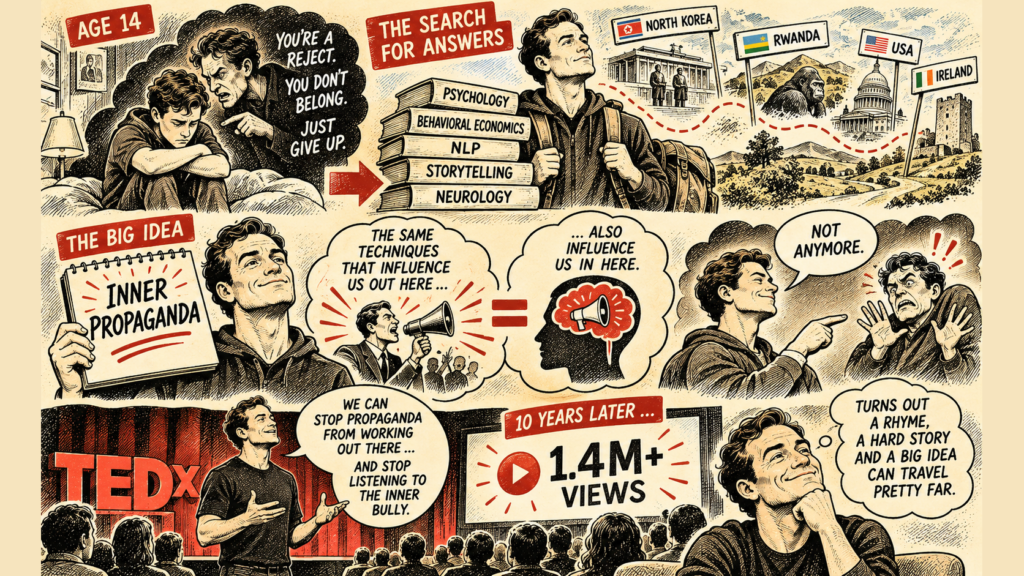
The talk opens with me at 14 years old.
“My heart was in pain. The abuse, psychological.” An inner bully telling me I was a reject, that I would never be accepted, that “I'd suffer lost and alone until the day I died.” A voice suggesting I “write a suicide note, say goodbye, and just go.” I stood on that stage at 38 and admitted that “24 years later, he was still around. Plenty more tears later, and he still makes a sound.”
I had mentioned the suicidal period briefly here and there before. This was the first time I put the full experience in front of an audience in that way, and I did it in rhyme, because I wanted it to land as a memorable experience as opposed to an ‘origin story’.
Then I showed my research and experiences of what brought me to that point. By that point I had studied psychology, behavioral economics, NLP, Robert McKee's work on storytelling, and neuroscience. I had traveled to North Korea, to Rwanda, through Irish history, looking at propaganda and how it works. And standing in the Rwandan genocide memorial, I understood something that shaped everything since. One of the lines I like a lot: “Behind every bomb and every mass killing are voices that convince people to create hell. We've got voices in our head that do that as well.”
Watching it back, what strikes me is how much of that talk became the book Inner Propaganda. The Rwanda chapter. The Irish history. The war of voices. I didn't plan it that way. The talk was the seed, and it took ten years to grow.
The rap battle in your head
The battles themselves are where the talk gets uncomfortable, because the inner dictator gets to speak, and he's vicious.
He opens by telling me I'm the odd one out. That “the only time girls like me is when they think I'm wealthy.” That I have nothing to show for part two of my life. The ultimate midlife crisis. When I try to push back with my accomplishments- six books and ninety countries at the time, he delivers my favorite burn in the whole talk: "You want a medal 'cause you can book a flight? Or put words together on a computer, right?"
I love that line because it's exactly how the inner dictator works. He takes any evidence you offer and reframes it into nothing. Traveling to ninety countries is just booking flights. Writing books is just typing. The dictator doesn't argue with your facts. He poisons the meaning of them.
In the final battle, the good voice becomes stronger. The dictator says I'm like a fly who can't fly, dying inside. The response begins with three words: "Maybe you're right."
That's the disarm. The kudos inoculation. You stop defending, you concede the possibility, and then you turn. "Maybe there's no light. Maybe no hope in sight. But maybe I gotta fight." From there the voice gets stronger. “Show me the evidence. You're going to suffer? No, I'm struggling on.” Struggling means you're doing something about it. Suffering means you're letting it happen to you. “I'll fight like a warrior standing in the arena. Like Ireland, my homeland that fought to be free, I'll fight so that free in my mind I can be.” Once more, the reference to Ireland, whose struggle appears in the book multiple times, ten years later.
Then, because I love my puns, the dictator finally gets his name. I'm sick of your lies. You're a dick and a hater.
The line everyone remembered
There's one line in the talk that has no rhyme at all, and that was deliberate.
"When you're depressed, you don't think negatively. When you're depressed, you believe negatively."
I wanted it to stand out from everything around it, naked, no rhythm to hide behind. It worked. More people have mentioned that line in the comments than any other because it names the real problem. Negative thoughts are just thoughts. The damage happens when the propaganda convinces you they're true. “We find ourselves stuck to our positions like we're the convicts of our own convictions”, and I'd argue that line about social media is more accurate today than it was in 2016.
So what do you do about it? The suggestions are many of the same tools I teach now. Ask the voice questions. How do you know that's true? In what way? Challenge the certainty. “Refuse to accept it, choose to reject it. As Richard Bandler would say, start thinking on purpose”, a phrase I loved so much it became a book I later wrote with him and Glenda Bradstock. Above all, change the role you're playing in your own story. Not the victim. Not the monster. The hero. Something I’ve been discussing a lot lately.
Ten years on
So that's the 38-year-old on the stage, and here's the 48-year-old watching him back.
Since that night, six books became ten. Ninety countries became 107. The term I said out loud for the first time became a USA Today and LA Times top ten bestselling book, a podcast, and this newsletter. And the inner dictator? Still around. He thought doing this reaction episode was a ridiculous idea, for the record. He had plenty to say about the quality of the rapping too, and honestly, on that one point, the Eminem line got there first: “I'm like Eminem without the skill, words, or timing.” One of my other favorite lines!
But that's the message of the talk. The voice doesn't retire. You just get better at the battle. You learn to ask for the evidence, to disarm before you counter, to struggle instead of suffer, and to remember that just because the story feels true doesn't mean it is.
If the voice in your head is loud right now, please reach out and talk to somebody. If you want to watch a nervous Irishman rap battle himself in front of a stunned audience, the talk is ten years old this month and holding up better than I expected.
Watch the full podcast episode here.
Belief Leader of the Week
Sir Ken Robinson
Since this week's issue is about a talk on a red circle, it has to be the man who gave the most-watched TED talk of all time. In 2006, Sir Ken Robinson walked onto the TED stage with no slides and no props and delivered "Do schools kill creativity?", eighteen minutes that have now been viewed more than 70 million times. His key idea was simple and radical: creativity is as important in education as literacy, and we should treat it with the same status. Instead, he argued, we educate children out of their creative capacities, because our schools stigmatize mistakes, and as he put it, if you're not prepared to be wrong, you'll never come up with anything original.
Why was it so good? Because he practiced everything he preached. He told stories instead of reciting research, like Gillian Lynne, the fidgety schoolgirl in the 1930s whose doctor turned on the radio, watched her move, and told her mother, "Gillian isn't sick. She's a dancer." Lynne went on to choreograph Cats and The Phantom of the Opera.
Ken was funnier than most professional comedians, which meant the audience's guard was down when the serious idea arrived. He compressed a lifetime of thinking into one memorable question that fit in the title. Robinson passed away in 2020, but his belief lives on in every teacher and parent who treats a child's imagination as a capacity to develop rather than a behavior to correct. Start with the talk itself on TED.com, then read his book The Element, about what happens when natural talent meets personal passion.
Watch Sir Ken's TED talk here.