
For years, there was a voice inside my head that told me I was worthless.
The most dangerous thing about it was never the cruelty. It was that it didn't sound like a voice. It didn't feel like self-talk or a mood or a symptom with a name. It felt like the truth. Calm. Authoritative. Someone finally sitting me down and telling me, for my own good, how things really were.
If you don't know what I'm talking about, genuinely, I'm glad. But if you do know, if there's a broadcast like that running somewhere inside your head right now, this might be the most important thing I ever share with you.
Because it took me 30 years and trips to the most propagandized places on Earth to work out what that voice actually is. That voice is inner propaganda, broadcasting around the clock from a station inside your own skull.
Drumroll, please... This week is the week my book about it finally comes out. I want to walk you through the three insights that changed my life here.
I’m so excited to share the book with the world. Inner Propaganda: Leading Hearts and Minds Through Turbulent Times is out today, and it's the work I've poured my heart, soul, and energy into. World War Two spies. Propagandists throughout history. My travels to North Korea, Rwanda, and Afghanistan. Irish revolutionary history. All of it in service of one question: why do we believe what we believe?
How to question the propaganda in your head
Back in 2016, I gave a TEDx talk, and it was the first time I ever said the words inner propaganda in public. I'd been circling the idea for years, but that was the day it got a name. And the name matters.
When I was younger, I struggled with depression for a long time. I was suicidal as a teenager. People would talk to me about the inner critic, this little negative voice that gives you a hard time. That description never made sense to me, because a critic is someone you can argue with. A critic is an opinion. Whenever my voice communicated with me, there were no other opinions. When it said "You're not good enough," it said it the same way it would say water is wet or gravity exists.
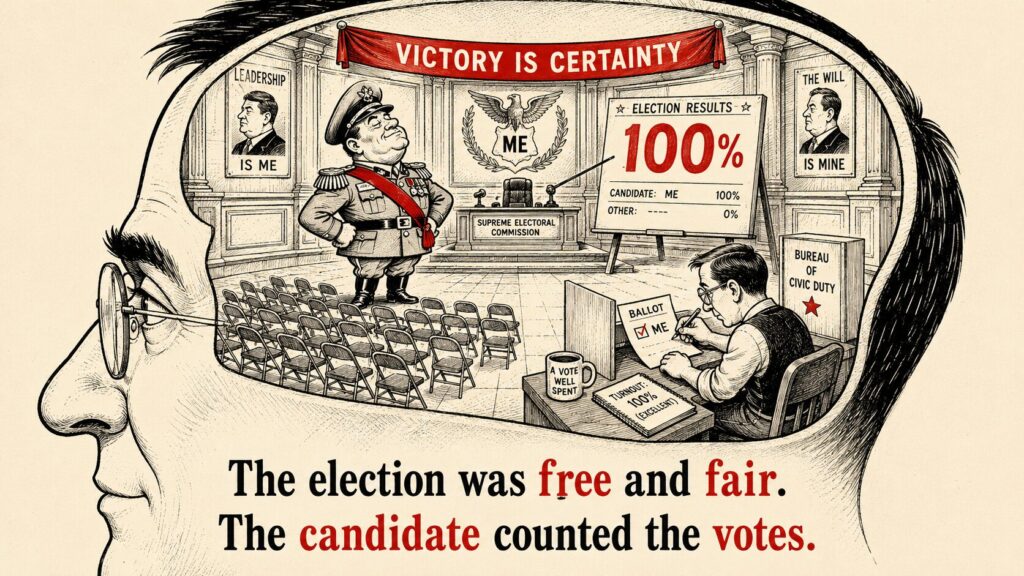
So I stopped calling mine an inner critic, because that felt like giving it far too much credit. I called it what it felt like. An inner dictator. A critic gives notes. A dictator doesn't take notes, doesn't run for re-election, doesn't hold a referendum. It decides what you're allowed to think. And this is the genius of it. It convinces you that you thought of it yourself.
For 30 years, I've been studying one question: why do we believe what we believe? That question dragged me to North Korea, Afghanistan, Iran, and Rwanda. In North Korea, I watched the evening news, and I have to tell you, it was the most positive news I've ever consumed. Record harvests. A football team doing brilliantly. The greatest leader ever to draw breath. But the entire nation's reality is being furnished wall to wall out of this story, and a lot of people are suffering behind the scenes as a result.
What I really took from that experience was this. We all use the same strategies inside our own heads that propaganda states use. A state floods you with feeling and orients your attention. Your brain does the same thing to maintain your mood. I call it your inner state media. A state runs indoctrination, bending every message to construct your identity so you never think to question it. We do that too, defending our sense of who we are at all costs. I call it internal indoctrination. And a state does truth engineering, where a story becomes so coherent and emotionally satisfying that everyone forgets to ask if it's true. Our brain pulls this one on us daily.
I've studied the most successful persuaders history has ever seen, and the most sophisticated one I ever found was living rent-free inside my own head. Three insights helped me deal with him.
Believing it doesn't make it true
In 1951, a psychologist named Solomon Asch ran an experiment that was ridiculously simple. He showed people one line, then three more, and asked which of the three matched the first. A child could do it with one eye shut. Except everyone else in the room was an actor, and one by one, out loud, they all confidently gave the wrong answer. When it came to the real participant, a huge chunk of them looked at the line they could plainly see was wrong and gave the wrong answer too. Rather than stand alone for three seconds, they denied the evidence in front of their own eyes.
If we'll override what's literally in front of our faces to keep the peace with a room of strangers, what chance do our everyday beliefs stand? The ones with no line to check them against. The ones about who we are or what we're worth. A related concept called naive realism suggests that we're all convinced we're the rational ones, and everyone else is convinced they are too.
In the book, I talk about the five types of truth. Past truth is what we remember as true, and our memory is a notoriously shameless liar. Daniel Kahneman showed in 1993 that people’s later evaluation of an unpleasant experience was disproportionately shaped by its most intense moment and its ending. Your memory is a highlights reel cut by an editor with an agenda. Objective truth is what we can actually prove, the kind you'd build an airplane out of. Shared truth is when we believe something because everyone around us agrees, the membership fee we pay to belong to the group. Emotional truth is believing something because we feel it. And desired truth is believing a thing because we want to.
Here's the sting. Every one of us walks around convinced we're dealing in objective truth all the time, and we rarely are. So pause and ask: which of the five truths is this for me? Is this objectively true, or is it what I want to be true? Am I believing this because I feel it, or because other people agree with it? The moment you start asking, you start thinking clearly, and you start understanding other people at the same time.
You're allowed to change your beliefs
The second insight handed me hope back when I was badly short of it. You can change your beliefs. Far from being a weakness, it might be the strongest thing a person can do.
You've probably heard of Professor Carol Dweck's mindset work. She gave school kids really difficult puzzles and found that some relished them and some hated them. She called the difference having either a fixed mindset, where you believe your ability is carved in stone, or a growth mindset, where you believe you can build it with effort, feedback, and challenge. This refers to our intelligence or abilities, but what about beliefs? Very rarely does anyone say "I've changed my beliefs" as if it's a good thing. Most of us have a fixed mindset about what we believe. Our beliefs feel permanent and non-negotiable, which is why we defend them like we're defending our lives. That's exactly how it feels.
What I argue for instead is a belief growth mindset. Your beliefs are like your clothes rather than your bones. You decide to wear them; some fit for a while, and then they no longer fit. This is influenced by Thomas Bayes and Bayesian reasoning from three hundred years ago. You go into a situation with a prior, and you correct that prior based on the evidence that comes in. The old me was certain that my beliefs about myself were facts. They were propaganda I'd learned. When you permit yourself to update them, it can transform your life.
Feeling first, identity second, logic last
The third insight is the engine of the whole book. How beliefs actually change, in you and in anyone you're trying to reach.
My framework suggests that a belief has to pass through three gates, and those gates come in a particular order. Gate one: it has to feel right. An emotional yes before anything else. Gate two: it has to fit in with who you believe you are, with your tribe, with your sense of meaning. Gate three: last, always last, it has to make sense. The logic, the evidence, the story.
Has anyone in the history of arguments ever hit you with so many facts that you stopped and said, "You know what? You've brought excellent data. I'm wrong about everything." Unlikely. And the reason is that facts arrive too late. If gates one and two have been bolted shut from the inside, there's no way through. You cannot logic someone through a door that their feelings and identity have locked.
So here's something you can use straight away with your kids, your partner, your boss, or yourself. Whenever you want to change a mind, focus on the feeling first, the identity second, and the logic last. Every single time.
Robert Cialdini spent a career, from the first edition of Influence in 1984 to its latest in 2021, showing us how other people persuade us. This book is about how we persuade ourselves. And the way we influence ourselves is by producing a better feeling, long before we produce a better argument. That's the foundation of the field I care most about, belief leadership. The whole idea hides in a phrase you've said a hundred times without hearing it. We talk about winning hearts and minds. Nobody ever says minds and hearts. The hearts come first, and the minds follow. A leader tells you what to believe. A belief leader shows you who you could become by believing it, and lets that do the rest.
The most important propaganda of all
Let me bring you back to that voice I started with. The one that sounds like the truth.
I believed it for years. It simply never occurred to me that I was allowed not to believe it. I didn't know it was propaganda. I didn't know there were different kinds of truth. I didn't know beliefs could be rewritten, and I had no idea they were built by feeling rather than logic. The voice nearly got the last word. It nearly led me to end my life.
Instead, understanding all of this became the work of 30 years. This week, it becomes a book you can hold in your hands. Inner Propaganda: Leading Hearts and Minds Through Turbulent Times is out today, and it's the work I've poured my heart, soul, and energy into across nine previous books and an entire career. World War Two spies. Propagandists throughout history. My travels to North Korea, Rwanda, and Afghanistan. Irish revolutionary history.
If you're thinking of getting it, please do get it this week. It helps me more than you can imagine as I try to make it a bestseller. You'll find it at innerpropaganda.com. If you read it, an honest review on Amazon or Goodreads would mean the world. It will be available in Ireland and the UK at the beginning of October!
So if you take one thing from everything I've said today, take this. The most important propaganda you will ever learn to question is the kind that speaks in your own voice. You're allowed to question it. You're allowed to change your mind about who you are. That idea transformed my life, and this week it finally goes out into the world.
One final word. If anything I described about that voice sounded familiar and you're struggling, please don't carry it alone. Talk to someone you trust. Talk to a professional. You don't have to believe everything that voice tells you. I'm living proof, and I'm living as a result of it.
Learn more in this week's Inner Propaganda Podcast episode.
Belief Leader of the Week
Here’s to all the speakers, thought leaders, writers, experts, preachers, teachers, artists who do what they can to spread messages of hope, motivation, self-belief, and resilience. Life isn’t easy. There are so many people whom I’ve learned from over the years whose messages are the reason for me still being around today and having the life I have. So here is to all the Belief Leaders who change what we believe and help us believe better. I hope that these newsletters help you in the same way. This week, I would love to hear from you.
Who are the people in your life that you’ve listened to, learned from, read from, or seen who have changed your beliefs… and why did they succeed?