
A school principal, let's call her Principal Reeves, opens her inbox to find a long, anguished email from a mother. Her son has been through a behavioral incident at school, there's emotional turmoil at home, and the email has clearly taken this woman the better part of an hour to write.
The principal is due at the bus stop parking lot in minutes and has a hundred other emails waiting. She cares. So she writes a thoughtful, personalized response and sends it straight away. It lands in the mother's inbox eight minutes after she hit send.
And the mother's reaction? "BS. You didn't write this. AI wrote this."
Not good.
That story comes from Henna Pryor, the workplace performance expert and author who joined me on this week's podcast to talk about her brilliant new book, The Signal Gap. It captures something that has quietly changed about the world you're communicating in.
For most of history, the default between humans was trust, then verify. You trusted people until something smelled off, and only then did you go digging. That order has flipped. We now verify first, or verify during, and decide afterward whether someone deserves our trust. Henna calls this the verification era, and a gap opens up within it. The signal gap is the distance between the message you're hoping to send and what a verifying, skeptical audience actually receives.
Which means the game has changed. Being honest is no longer sufficient. Being right is no longer sufficient. You have to be believable, and today we're going to look at how.
Quick aside - the Inner Propaganda audiobook is now available. If you’ve been meaning to read the book and haven’t found the time, this is your chance. Would LOVE a review once you do. Listen now on Audible.
Why nobody believes you anymore
Why did trust flip and how did we end up in the verification era? Henna points to one tactical reason above all. The internet made your past signals permanent. Everything you've ever posted, said, or replied to now sits in a permanent, frozen, searchable record. All it takes is someone holding one of your past signals up against a current one and catching a contradiction, and that takes about four seconds. Her teenagers can do it on their phones.
Once a person has been bamboozled once, they start assuming there's a contradiction to find in everyone. Up goes the wall.
The data backs this up. Pew research shows a majority of people now believe you can't be too careful around another human being. Think about that for a second. The default approach to you, before you've said a word, is caution.
Henna wrote a line in the book that stopped me when I read it. "This is fake" is now indistinguishable from "I think this is fake." If someone decides your message, your reply, or your sincerity is fake, that belief functions exactly like the truth for them. The mother who received the eight-minute reply didn't investigate whether the principal wrote it. She felt something was off, and the feeling became the verdict.
Here's the strange twist, though. While we trust institutions, governments, and corporate leadership less than ever, we trust people in our perceived personal circle more than ever. That circle now includes people we've never met. The guy in the hoodie on TikTok telling you how to get ahead at work gets more benefit of the doubt than your own CEO. Psychologists call these parasocial relationships. Watch someone often enough, and they start to feel like a friend, so you stop checking. Skepticism skyrockets in one direction while gullibility grows in the other. That's the terrain.
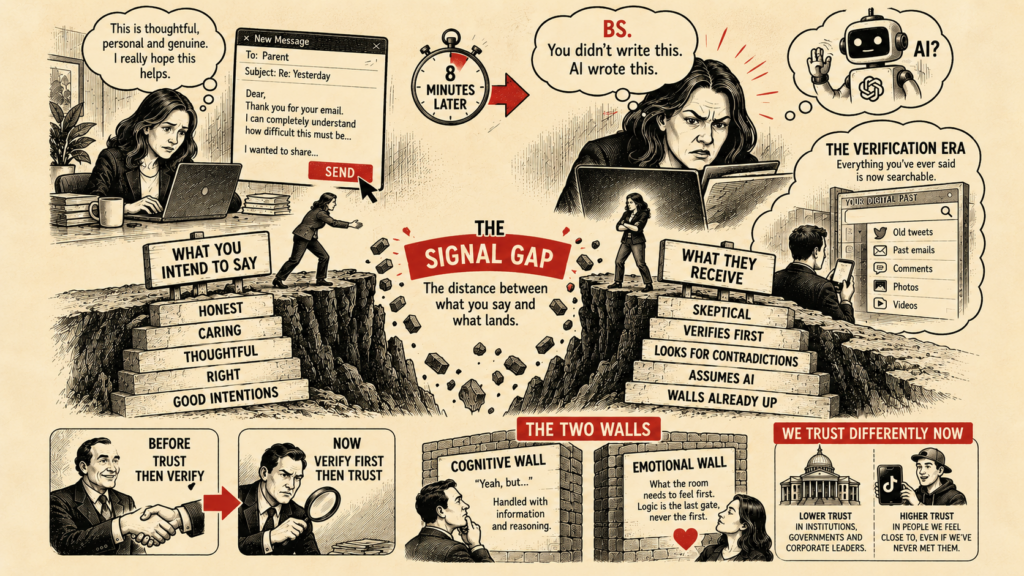
The two walls
So how do you communicate into all that skepticism? Henna's starting assumption is that nearly everyone now arrives at a conversation with a wall already up. Your job is to work out which kind.
The cognitive wall is the "yeah, but" running through their mind. It's the closest thing to a classic objection. You're saying this, but I'm worried about that. Leaders and salespeople have been trained on this wall for decades, and it comes down with information and reasoning.
The emotional wall is different, and it's the one people struggle with. It's what the room needs to feel before anything you say even has a chance of getting through. This lines up exactly with the model at the heart of Inner Propaganda. For a belief to take hold, it must feel right, fit in with who the person is, and only then make sense. Logic is the last gate, never the first. If you start making your case before the emotional wall is down, you're presenting evidence to a jury that has already left the room. That wall requires patience and presence, and it gets dealt with before the arguments do.
Name your intent
Once you understand the walls, the fastest way through them is what Henna calls communication congruence. Name your intent. Say the thing they're already thinking before they have to think it.
Her favorite current example is the mayor of New York, Zohran Mamdani. What's unusual about him is that he leads with the con. Announcing a project to make the city's scaffolding less hideous, he says up front that it's going to cost New Yorkers real money, then explains why he believes it's worth the price. Most politicians would bury the cost and sell the benefits. By naming the downside first, the thing every listener was silently waiting to catch him hiding, the wall drops an inch. It’s not a case of turning the other side of the aisle into super fans. Instead, he's done something more interesting. Far fewer people over there hate his guts, because they feel he isn't hiding the ball. That's the realistic goal in a polarized world. You're hoping they come a few inches closer in perspective.
Here’s the thing about signal gaps that we both kept coming back to. They rarely come from low intent. Principal Reeves wasn't lazy or careless but was optimizing for speed because she didn't want to leave a worried mother hanging. What she optimized for and what the mother received were two different messages. There was a high intent, but a wide gap.
The beige trap
Now for the failure mode, because there's a very public one playing out as I write this.
When something controversial erupts, the traditional playbook says go vague. Bring in the crisis team, let legal sand down every sentence, and release a statement that pretends to say something while saying nothing. Henna calls this executive beige. In a vacuum, that might hold. But nobody lives in a vacuum anymore. This is what Henna calls character congruence. Does the person someone meets on a normal afternoon match the person they've watched online over months and years? Beige feels safe because it takes no side. Except it does take a side. The side it takes is hiding, and audiences can smell it even when they can't name it.
The standard you set for yourself
The insight from the book that Henna says changed her own behavior the most comes near the end.
Every time you publish a LinkedIn post, reply to a comment, drop a message in the company Slack, or hit reply-all, you are setting a self-set standard of who you claim to be. Write "I have an open door policy" or "vulnerability at work matters to me" and you have just created a permanent, frozen, searchable benchmark that people will hold you to, whether they realize they're doing it or not. One great post proves nothing anymore, because anyone can write one great post. The only signal people still trust is your pattern over time.
So what do you do when you're asked, on the record, about something outside your lane? Henna gave me her exact script, and I love it. Something like: "Honestly, that's heavily outside my domain, so I don't want to speak with any authority here. Based on the little I know, here's my best guess. And if you know more about this than I do, I'd genuinely love to hear it." Our mutual friend Tamsen Webster has a similar move I've always admired. She prefixes her positions with "my current understanding is." It timestamps the thought and leaves the door open for the thought to grow.
Watch the full podcast episode with Henna here.
Let’s go back to Principal Reeves one last time. Imagine she had named her intent in the first line. Something like: I'm replying quickly because I didn't want you to spend tonight wondering if anyone read this, and I'd like to talk properly tomorrow. Same care, same speed, same principal. The mother reads it completely differently, because the very thing that triggered her suspicion has been explained before it could fester.
That's the work now. In a world that verifies first and trusts second, you have to close the distance between what you mean and what lands. Name your intent. Take down the emotional wall before you argue. Skip the beige. Remember the standard you set with every message you send, because people are keeping the record even when you're not.
Henna's closing message on the podcast said it best. Believability is where everything lives and dies now. You can be the smartest person in the room, but if people don't believe you, you won't get very far.
Belief Leader of the Week
Henna Pryor
Henna Pryor is a workplace performance expert, keynote speaker, and one of the sharpest thinkers working today on how humans actually come across to each other. Her first book, Good Awkward, won an armful of awards and was named a Kirkus Reviews Best Book of the Year, and she writes as well as she thinks, which is saying something.
Her core insight is that we've crossed into a verification era. Trust is no longer the default between people, and the distance between what you intend to communicate and what a skeptical audience actually receives, the signal gap, has become the defining challenge of modern influence. Credibility gets you considered. Congruence gets you believed.
Her brand-new book, The Signal Gap, is out this week, and it's one of the best books I've read on influence in years. Fresh ideas, rigorous research, and immediately practical. I was lucky enough to read an advance copy, and I devoured it. If you communicate for a living, and you do, this one is essential.
Learn more about Henna here.