
There's a Starbucks near my apartment that I love. Lovely staff, but there is one catch. No bathroom. If you need to go, they send you to the Dunkin' Donuts down the road, and the staff there make it very clear they mind.
While I was writing my book, I'd sit there for two or three hours at a stretch, drinking tea the entire time, and somewhere around hour two a negotiation would begin in my head. I need to go. Will I leave now? No, I'll push it a bit more. Just a bit more. Then, eventually, the seven-minute walk home was excruciating. I have done that walk more times than I will ever admit, and every single time, I knew exactly what was coming when I sat down.
I confessed all of this on the podcast this week to one of my closest friends, Cait Donovan, host of Fried, a top 1% podcast on burnout with over a million downloads, because her brilliant new book contains a line written for people like me: pee when you need to pee. But herein lies an important message for dealing with pushing things too far.
Her book is called Mismatch: Why Good People Burn Out in Good Organizations; it's out this week, and it takes on the biggest myth we hold about burnout. We think burnout means working too hard for too long. Too many hours, too much pressure, and not enough vacations. Cait's own story demolishes that. When she burned out as an acupuncturist, she was working 25 hours a week, seeing 40 patients, free to exercise every morning and have lunch with friends. She burned out anyway. Years later, rereading a research paper called Job Burnout, one line hit her like a punch in the gut. The largest driver of burnout is a mismatch between a person and their role. It wasn’t too many hours. It was a lack of fit.
Before we get into it, a lot of you have been asking me when Inner Propaganda will be available as an audiobook…. Well, I have fantastic news. It’s finally out. I spent time in the recording booth narrating every chapter myself. It gave me a chance to revisit the stories from my work in North Korea, Rwanda, and Afghanistan, and to share the 'Feels Right, Fits In, Makes Sense' framework exactly the way I hear it in my head. I also mispronounce just enough names to keep you on your toes!
If you’ve been meaning to read the book and haven’t found the time, this is your chance. Press play and let me walk you through it. Would LOVE a review once you do. Listen now on Audible.
Why good people burn out in good jobs
When Cait's burnout arrived in the late 2000s, exhausted, furious, practicing loving kindness meditations in shops because every human being irritated her, she found a culprit: Poland, where she was living at the time.
So, she moved to Prague. A couple of years later, the exhaustion, the weight gain, and the anger all returned, having apparently followed her across the border.
That's what she now calls the biggest mistake people make about burnout: blame. Sometimes we make someone else the villain, the boss, the company, the country. Sometimes we make ourselves the villain.
Of course, real bullying and real ostracism exist and absolutely belong in some burnout stories. But blame has never gotten a single person closer to healing. It keeps you stuck in a waiting room: until this company changes, until this person changes, I'm stuck. Her experience with hundreds of burnout recoveries says that's simply not true. The way out is to look at the situation as objectively as you can, solve the problems you control, buy back some energy, and then face the rest. Which starts with knowing where mismatches actually exist.
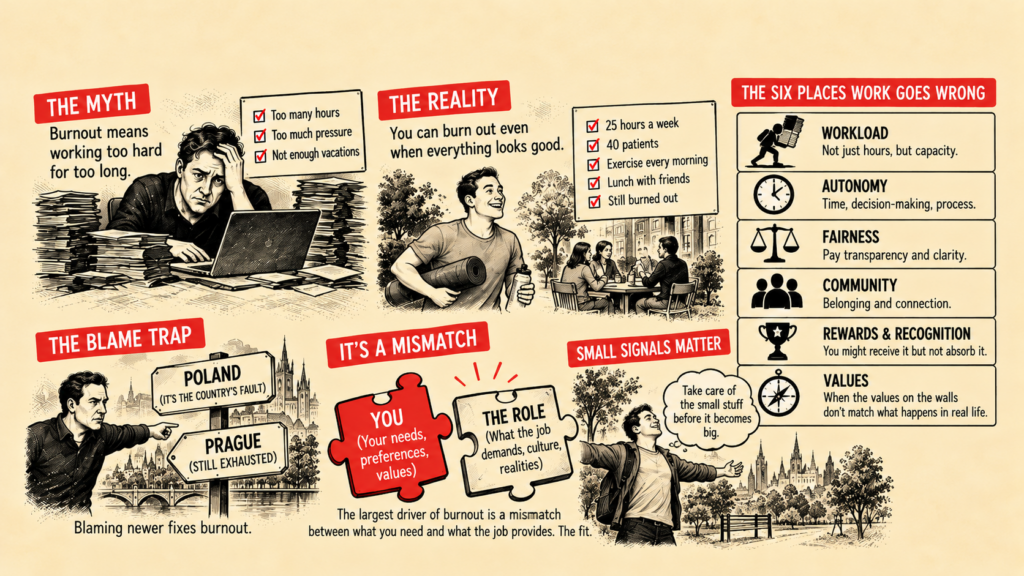
The six places work goes wrong
Researchers have been mapping this for about 45 years, and they name six areas where person and workplace can fail to fit.
Workload is one, and it includes capacity. If you're a mother who broke her hip last night while your child started vomiting this morning, you have less capacity today than last week, and when that persists, the same job becomes too tough. Rotating shifts that scramble your body clock count as well.
Autonomy is the second, and it comes in three forms: time, decision-making, and process. The key insight is that there's no correct amount. Cait runs high on all three. She once accidentally ordered 1,000 book plates instead of 100, paid for the mistake, and was perfectly content, because owning her decisions matters more to her than being protected from them. Her mother wants the opposite: a list from someone else, checked off and handed in at the end of the day. Neither way is wrong. If Cait follows an inefficient process, it will crush her daily. Give her mother total freedom and the pressure would do the same. The mismatch is the problem, never the preference.
Fairness is next, which covers pay transparency and clarity. Community, the entire universe of belonging. Rewards and recognition, with a twist I loved: you might be receiving recognition and be unable to absorb it. Someone congratulates you on the bestseller list; you wave it off with a "sure, look" and your brain never gets the chemical flood that would have buffered you. Finally, values. The biggest burnout-creating mismatch is when the values on the walls don't match the values in the halls. A beautiful painted mission statement, contradicted daily in the corridors beneath it, is an example of an organization mismatched with itself, and underneath it, broken trust.
Left unaddressed, these compound into everything companies say they're mystified by: attrition, conflict, disengagement, quiet quitting. Nearly every "people problem" has a mismatch underneath it.
Why you accept the mismatch
The second half of the book asks the question: What made you tolerate the bad fit for so long?
Family of origin comes first. If your childhood held trauma, chaos, or neglect, you may not know what alignment feels like. Nobody taught you to read your own signals, so a mismatched life reads as normal life. Then coping mechanisms: perfectionism, hyper-independence, people-pleasing. Ask a room of American professionals who's a perfectionist and 75% raise their hands, half of them proudly, because we're taught it's a virtue until it crushes us. Brené Brown told us otherwise in The Gifts of Imperfection long ago, but we're still doing it.
Then your health, because chronic illness, neurodivergence, anxiety, or depression all make matching harder when you need to ask for more. Next, culture, from the bootstrap Puritanism baked into American work to the double burden carried by first- and second-generation immigrants balancing two cultures inside one body and mind.
Finally, there is the environment, the bucket that surprised Cait most in her research. There's evidence that hospital waiting room design affects surgical outcomes, and that a home full of sharp corners can nudge your sympathetic nervous system toward stress without you ever noticing. Change the small things you control, recover the energy, then take on the big mismatches.
The bathroom, the coffee, and the glass of water
So, where do you start?
With the skill of interoception, the neurological process of noticing your body's signals and responding to them. Every time you override the signal- three more emails first- the part of your brain that reads internal signals gets a little duller. It's the same equipment you use to read emotions. You cannot develop emotional granularity, telling frustration from anger from fear, while ignoring a body that's telling you it needs to eat, rest, or go to the bathroom. Hence: pee when you need to pee. The full skill even includes a little celebration afterward. I noticed, I acted; well done me. Finally, after all these years, getting rewarded again for going to the toilet successfully.
I asked her whether hyper-aware people, the ones who notice every potential issue with their body, have the opposite problem to oblivious people like me. Her answer surprised me. Both are low interoception, because both misread the signal. One misses it entirely; the other inflates it into catastrophe and gets stuck spiraling. Notice it, respond proportionately, move on. That's the key.
Once we’ve done this, we extend it outward. Cait was a severe people-pleaser until it nearly destroyed her health, and her recovery practice was to disappoint people in small ways, on purpose. Same with asking for help. For nine years of marriage, her husband offered to make her a coffee every time he made one, and every time she refused and made her own, to avoid being a bother. He was offering. When she finally said yes, and specified it should taste like dessert, he laughed and made it. Her homework for the rest of us: when someone's heading to the kitchen anyway, ask for a glass of water. You don't need the water. You need the evidence, logged in your nervous system, that asking is safe.
Watch the full conversation with Cait on the podcast here.
Back to my Starbucks. A grown man, a psychologist no less, sitting in a coffee shop deliberately overriding the most basic signal his body sends, then doing the agonized shuffle home and calling it normal. That's a mismatch in miniature. I knew the signal, I knew the outcome, and the story I sold myself said push it a bit more.
Perfect match, by the way, is neither the goal nor possible. Cait works for herself, has no children, controls all of her own time, and still has mismatches. Mismatch only becomes dangerous when it goes unnoticed, unaddressed, and starts compounding across buckets.
Her one-idea brainwash for the world says it best: burnout is not your fault. It is fixable, one mismatch at a time. Starting with the smallest, silliest one of all. Go when you need to go.
Belief Leader of the Week
Cait Donovan
Cait Donovan is a keynote speaker, burnout expert, and host of Fried, a top 1% podcast with over a million downloads. She has 4,100 five-star keynote reviews and a 99% approval rating, and she's the person organizations call when they're finally ready to fix the real problem rather than hand out another wellness webinar. She's also one of my closest friends, and I don't bring anyone onto the podcast unless their thinking really impresses me, friendship or not
The core insight turns the entire burnout conversation on its head. Burnout was never really about working too hard. It's driven by mismatch, the compounding gaps between who you are and what your role, workplace, coping habits, and environment demand of you. That reframe moves burnout from a shameful personal failure to a set of nameable, solvable problems, and it explains why vacations, resilience training, and blame never cure it.
Her new book, Mismatch: Why Good People Burn Out in Good Organizations, is out this week, and it's phenomenal. Grounded in 45 years of research, funny, and immediately practical. If you've ever been exhausted by a job that looks fine on paper, or you lead people who are, get your hands on a copy.
Learn more about Cait here.