
Over two thousand years ago, Rome watched two of its most powerful men tear each other apart. Cicero, the greatest orator of his age, delivered a series of speeches against Mark Antony known as the Philippics, named after the attacks Demosthenes once launched at Philip of Macedonia. They were brutal. Cicero went after Antony's credibility, his character, his morals, everything. He obliterated the man's reputation in public, speech after speech.
Sound familiar? Turn on any news channel tonight, and you'll watch the modern version. Politicians attacking each other's integrity instead of each other's ideas. Pundits shouting talking points past one another. One token voice from the other side, given barely any time, wheeled out so the panel has something to unite against.
Here's the claim I want to make today, and I know how it sounds:
The problem in the world right now is that we're not disagreeing enough.
I'm serious. What we're watching every night isn't disagreement. It's people performing at each other with no intention of listening. Real disagreement, where two people who see the world differently actually have the conversation, has become so rare that most of us have given up on it. We look at someone on the other side and think, what's the point? You just can't talk to them. And that surrender is far more dangerous than any argument, because the only chance we ever have of changing a mind is if we're willing to have the conversation. Today, let's look at why we stopped, and how to start again.
A quick thanks to everyone for the reviews and feedback on my new book, Inner Propaganda: Leading Hearts and Minds Through Turbulent Times; you can find it here.
Why we need to disagree more
Why has a productive conversation about a contentious topic become so hard? Start with what we're being shown.
Research over the past few years keeps finding the same pattern. People on one political side dramatically overestimate how extreme the other side is, and overestimate how willing the other side is to endorse political violence. We're not reacting to our actual neighbors. We're reacting to a caricature.
The caricature gets fed to us daily, because attention flows to extremity. The most extreme voices are the loudest voices, so the algorithm serves us the other side's worst examples, our outrage confirms the algorithm's choice, and around we go. Meanwhile, the echo chamber reinforces everything we already believed until our view stops feeling like a view at all. It feels like the truth, the only truth, with no serious alternative. By the time we meet a real person from the other side, the gap between us feels too wide to even attempt.
So we don't attempt it, and into that silence, something worse occurs.
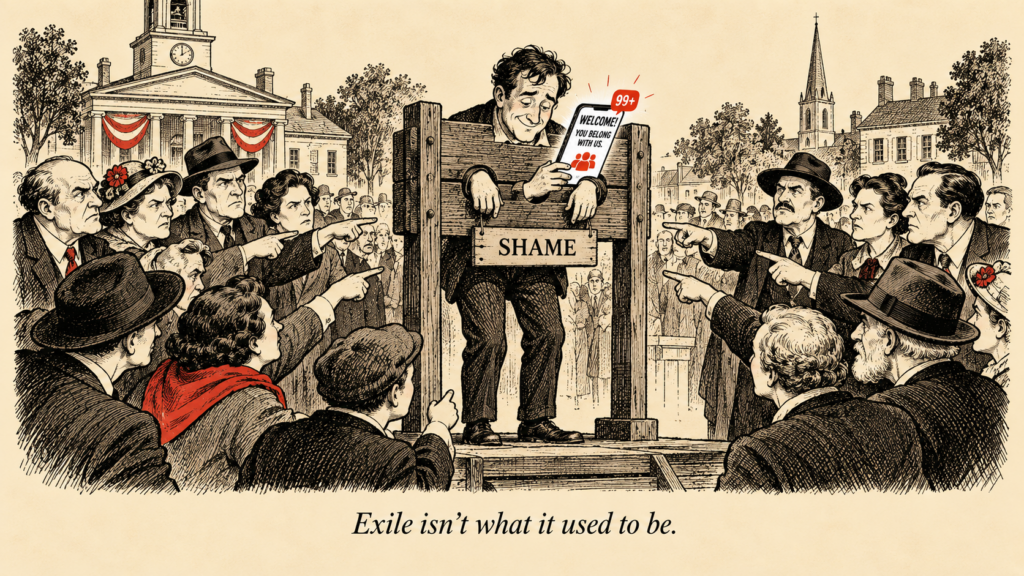
Shame builds the monster
For most of human history, shame was how the tribe kept you in line. Step out of line in a hunter-gatherer band, disagree with the group, refuse to comply, and you'd be shamed and ostracized. Banishment was close to a death sentence, so shame worked. It corrected behavior because there was nowhere else to go.
The 21st century broke that mechanism completely, and we haven't noticed. Shame someone out of a group today, and they don't reform. They open their phone and find another group. Take young men. If a young man feels that mainstream society is telling him there's something wrong with him, that he's defective or dangerous or not good enough, he's not going to accept that verdict about himself. Nobody does. He goes looking for a tribe that tells him otherwise, and the more extreme corners of the manosphere are waiting with open arms, offering him a place where the problem was never him.
Shaming doesn't correct the behavior anymore. Instead, it galvanizes people toward the very thing you're attacking. It has never been easier to manufacture your own enemy, to build, recruit for, and strengthen the exact monster you claim to stand against.
But surely, you might say, some things deserve shame. What about the Nazis? Fine, let's take the hardest case, because it proves the point rather than breaking it. The Nazis were a disgusting movement that caused suffering on an unimaginable scale, and plenty of people were aghast at what they were doing all through the 1930s. The moral outrage existed. It changed nothing.
Shame didn't stop them, because the catastrophe had already happened years earlier, when enough ignored, struggling, humiliated Germans, reeling from Versailles and the crash of 1929, were sold the easiest product any demagogue ever sells: an enemy. Point at the Jews, point at the communists, construct the story, and harvest the pain nobody else was willing to hear. The lesson of the 1930s isn't that we should have shamed harder. The lesson is that the conversations needed to happen a decade before, when the grievances were forming, and nobody was listening.
They are not monsters, and neither are you
Here's the uncomfortable part, and I include myself in this fully.
When someone says something I strongly disagree with, dismissing them feels right. Labeling them feels like moral clarity. But millions upon millions of ordinary Germans became proud Nazis, and you cannot seriously argue that human nature was fine everywhere on Earth except Germany, where the bad eggs happened to cluster. They were led there by circumstances and by stories they were sold. Had you or I grown up in exactly their situation, fed exactly their propaganda, we'd likely have believed exactly what they believed. When I visited North Korea a few years ago, I had to admit the same thing. If I'd been born there, I would not be the one enlightened person in thousands who sees through it all. Neither would you. Maybe we aren't as smart as we think, and accepting that is where shared humanity begins.
In Inner Propaganda, I wrote about my guide in Afghanistan telling me that women shouldn't play sports, and about stoning. I felt disgusted listening to him. Genuinely disgusted. What were my options? Argue with his religion? Picture how that ends. He gathers everyone around and announces that Owen Fitzpatrick, a random psychologist from Ireland, thinks women should play sports, so the entire culture will now be revising its views. Of course not. So instead I asked questions. I tried to uncover where the belief came from, the years and the culture underneath it. I walked away still disagreeing with every bit of it. But I understood him better; he felt heard rather than attacked, and the conversation stayed open. That's the only door influence ever walks through.
There's a psychological reason the attacking approach fails so reliably. Dan Kahan and his colleagues call it identity-protective cognition. When your position is challenged, your brain doesn't process it as a debate about facts. It processes it as an attack on who you are, and it defends accordingly. Threaten someone, and you guarantee they'll cling harder to the belief you're trying to dislodge. Facts bounce off a defended identity.
How to actually disagree
So what works? The best evidence I've seen comes from a practice called deep canvassing.
Canvassers knock on doors to talk about a contentious political issue, and they spend ten to twenty minutes doing almost everything backward. They don't tell the person why they should vote a certain way. They ask for the person's perspective, and when it differs from their own, they say they'd genuinely love to know why. Then comes the part that matters. They listen. Actually listen, trying to stand in the person's shoes. When the person finishes, they don't rebut a single point. They simply share their own perspective and connect it to the same values the person just expressed.
The research shows it works, and works durably, where debating and fact-bombing fail. Why? Because when we feel respected, we feel psychologically safe, and only a psychologically safe brain is open enough to reconsider anything. I call this cultivating a belief growth mindset, flexibility in what we believe because we don't feel under siege. Understanding people doesn't work every time either. Nothing does. But it's the best shot we have, and it's a far better shot than the shouting.
Notice what you get even when you don't change their mind. Ask someone for their steel man case, hear it fully, get curious about how they became so certain, and something else happens.
There's a phenomenon called the illusion of explanatory depth: people are confident they understand how a toilet works until you ask them to actually walk you through it, at which point the confidence collapses. Beliefs work the same way. Genuine questions let a person discover the gaps in their own reasoning, which no argument from you could ever show them. Both of you walk away with the caricature broken. They stop seeing you as the extremist they'd imagined, and you stop seeing them as one.
So, when I say we need to disagree better, I don’t mean arguing at each other. Nor do I mean simply debating our selective talking points. I mean being prepared to believe differently than others and pursue their perspective with as much curiosity as you can muster.
Watch the full podcast episode here.
This brings us back to Cicero. All that oratorical genius poured into destroying Mark Antony, and where did it get him? The feud ended with Cicero's head and hands nailed up in the Roman Forum. Two millennia of practice later, we're still running his playbook, attacking the person, winning the crowd, losing the mind we claimed to want to change.
The next time you catch yourself thinking you just can't talk to them, notice that thought for what it is. It's the surrender that makes everything worse. Have the conversation. Ask how they got so certain. Let them be fully human in front of you, and be fully human in front of them. Disagree more, and disagree better.
Belief Leader of the Week
Sarah Stein Lubrano
Dr. Sarah Stein Lubrano is a writer and researcher with a PhD from Oxford, formerly Head of Content at The School of Life, and one of the freshest thinkers around on why political persuasion fails and what actually works instead. Her research focuses on cognitive dissonance and the role of emotion in political life, from conspiracy theories to echo chambers
Her core insight is beautifully provocative. Democracy is struggling because we're clinging to an outdated myth: that talking about politics changes people's minds. Debate and the so-called marketplace of ideas simply don't function the way we assume. What actually shifts beliefs is lived experience and the strength of our relationships and communities, which means the real work of changing minds looks less like arguing and more like building friendships, organizing, and repairing the social infrastructure around us.
Her debut book, Don't Talk About Politics: How to Change 21st-Century Minds, is a rigorous, hopeful dismantling of debate culture, drawing on everything from ancient philosophy to modern neuroscience. If today's newsletter struck a chord, her book is the perfect next step.
Learn more about Sarah here.